Moving In Together? Set These Money Rules First
The moving in together finances conversation to have before you sign a lease — deposits, furniture, and who buys what — with a worked example.
Moving in together finances break more relationships than the actual move does. Not because anyone is bad with money, but because two people who’ve never split a single bill together suddenly have to agree on a lease, a deposit, a couch, and a system for the next twelve months — usually in the same week they’re also renting a truck and arguing about whether the mattress fits through the door. If you sign the lease before you’ve had the money conversation, you’re building the relationship on a foundation you haven’t actually tested.
This applies just as much to a couple leaving their parents’ places for the first time as to two people who’ve dated for two years and finally signed a lease together. The stakes are different, but the conversation is the same.
The Conversation to Have Before You Sign Anything
Have these four talks before the lease, not after:
- How will rent split? Evenly, by income, or by room size if the apartment has an obvious better/worse bedroom. Decide the method now, not when someone’s annoyed about the smaller closet.
- Who’s on the lease, and what happens if one of you leaves? This is the unromantic question nobody wants to ask, but a lease is a legal document and you should both know what happens if the relationship ends before the term does.
- What’s the recurring-bill list, and who owns each one? Rent, electric, internet, streaming, renters insurance. Someone has to be the one who actually calls to set up the internet account — decide who, and how the cost gets tracked.
- How do you handle one-off shared costs? Furniture, the U-Haul, the first grocery run to fill an empty kitchen. These add up faster than either of you expects.
If you’re coming straight out of college into your first apartment, add one more: figure out the security deposit and furniture budget together before you start shopping, because “I’ll just get what I need and we’ll sort it out later” is how one person ends up $600 in the hole for a couch the other person picked.
Moving In Together Finances: The Rules That Prevent Fights
You don’t need a joint bank account to move in together well — plenty of couples and roommates never open one and do fine. What you need is a system that survives someone forgetting to Venmo someone back.
- One shared record of what’s been paid. A shared note, spreadsheet, or app — anything beats trying to remember six weeks later who covered the Target run.
- A rule for groceries. Decide up front whether groceries are split evenly, alternated, or tracked item by item. This is one of the most common sources of quiet resentment because grocery habits differ so much between two people.
- A cutoff for “who cares” expenses. Agree that anything under some threshold — $10, $15 — doesn’t get tracked at all. Tracking every coffee run is its own kind of relationship tax.
- A monthly check-in. Five minutes, once a month, to settle up and flag anything that felt unfair. Waiting until resentment builds is worse than an awkward five-minute conversation.
If you want the deeper version of the rent-by-room-size question, split rent by room size fairly walks through methods for when bedrooms genuinely aren’t equal. And if you’re moving in as roommates rather than a couple, roommate bills without fights covers the ongoing utility and chore-adjacent expense fights that show up after the first month.
Worked Example: Splitting an $1,800 Move-In Cost Fairly
Say the move-in costs come to $1,800 total: a $1,200 security deposit plus $600 in furniture (a couch, a dining table, and a few basics). Person A earns $3,000/month after tax. Person B earns $5,000/month after tax.
A straight 50/50 split puts each person at $900. That’s clean, but it’s genuinely harder on Person A — $900 is 30% of their monthly take-home, while it’s only 18% for Person B. That gap is exactly the kind of thing that turns into quiet resentment three months in, even if nobody says anything at the time.
A proportional split by income looks different. Combined income is $8,000/month. Person A earns 37.5% of that, Person B earns 62.5%. Applied to $1,800: Person A pays $675, Person B pays $1,125. Both people are contributing the same share of their income, not the same dollar amount.
Neither method is objectively correct — it depends on what the two of you actually value. Some couples want even splits because “we’re a team, full stop,” and that’s a legitimate stance even if it’s mathematically harder on the lower earner. Just pick one on purpose instead of defaulting to 50/50 because it’s the path of least resistance.
If you’re already navigating this as a couple beyond the move-in costs, split household expenses as a couple goes deeper into ongoing models — 50/50, proportional, and yours/mine/ours — for after you’ve unpacked the last box.
Where an App Actually Helps
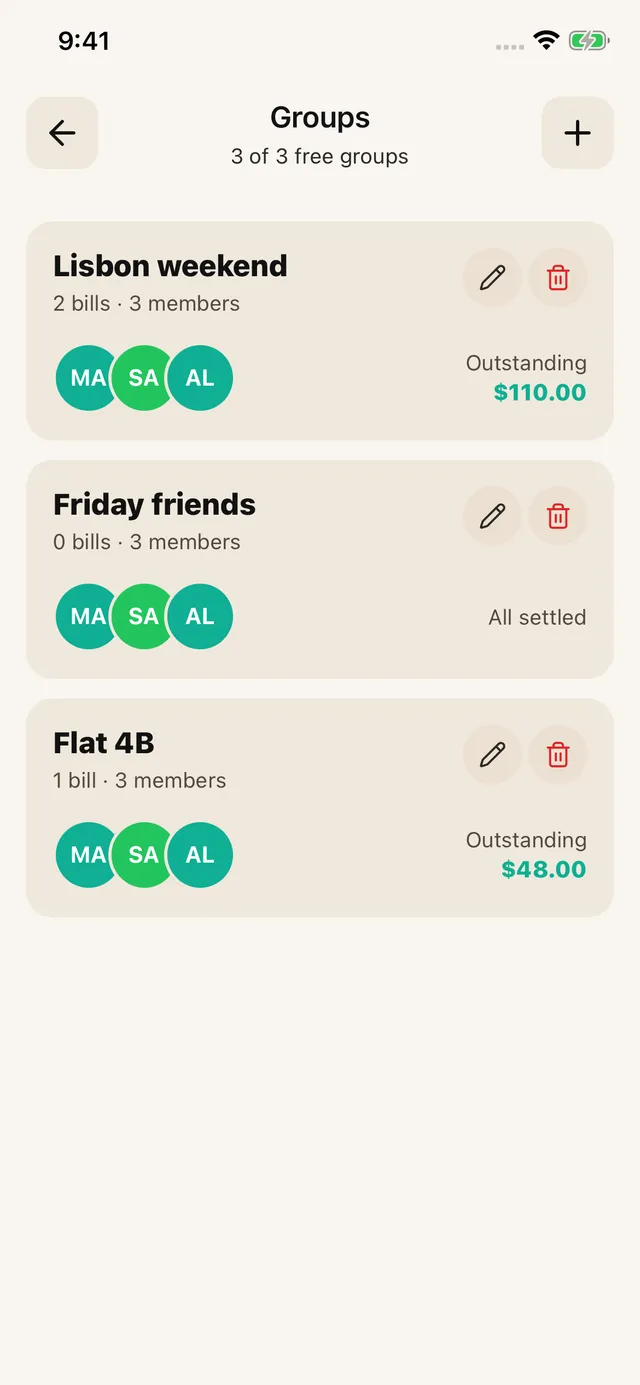
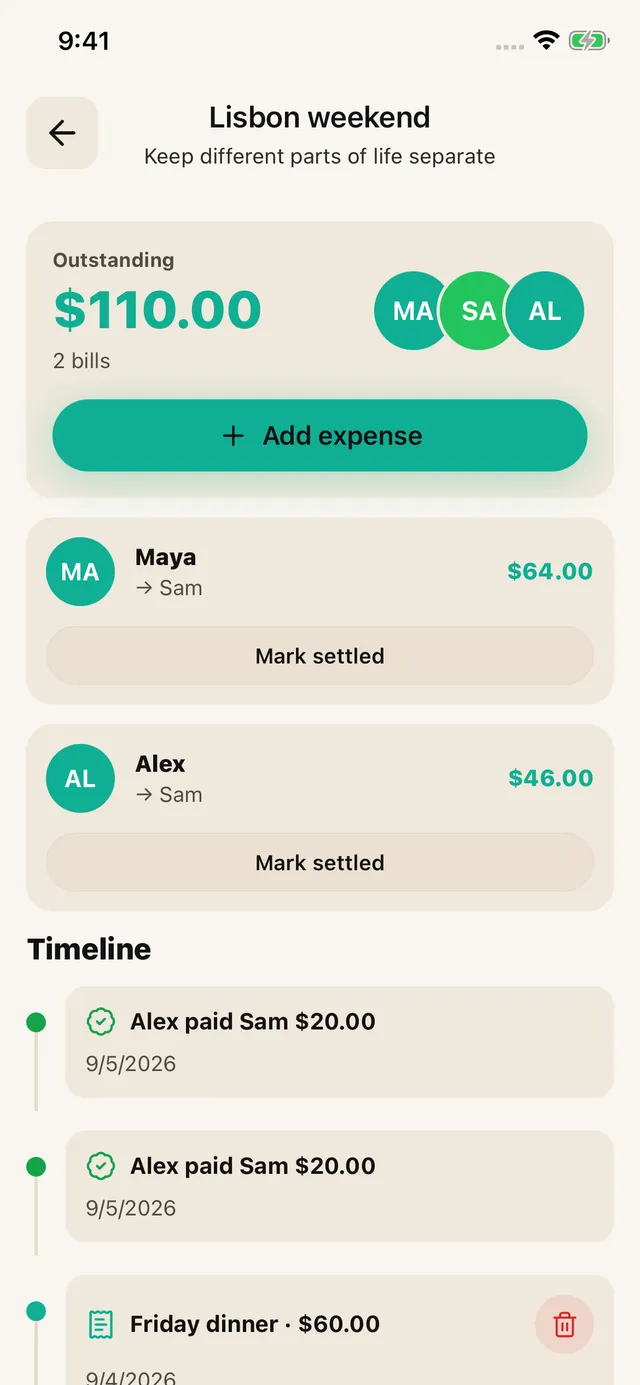
SPLIIT Pro: Assign household items to the household and personal items to their owner. Keep home expenses together in a roommate group. Record a partial repayment in the group, or use Debts for eligible ungrouped bills you paid. Add each new bill yourself; Expenses are not created automatically.
The Actual Rule
The couples and roommates who avoid money fights aren’t the ones with the fanciest spreadsheet. They’re the ones who had the uncomfortable conversation before the lease instead of after the first missed Venmo request. Pick your split method, name it out loud, and put it somewhere you’ll both actually look at again — not just in a text thread that gets buried by week three.
If tracking the ongoing costs becomes a hassle once you’ve settled in, SPLIIT handles that part too — snap the receipt, split it, done. Free on iOS and Android.