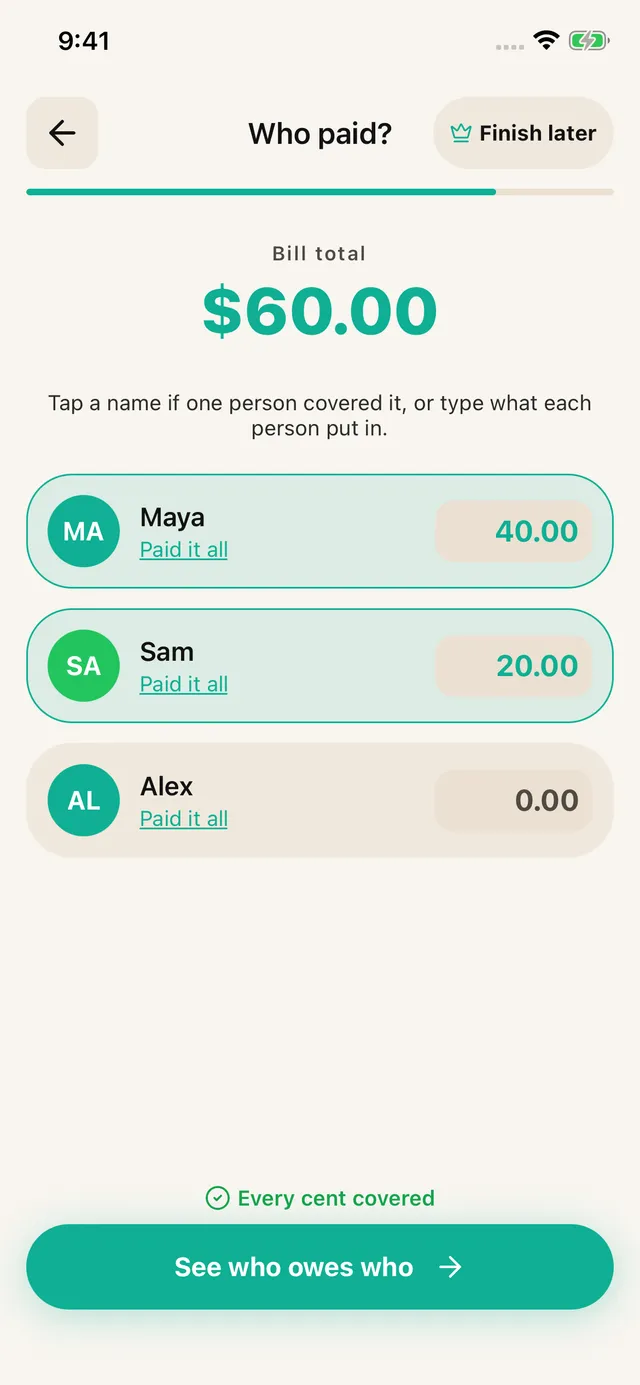
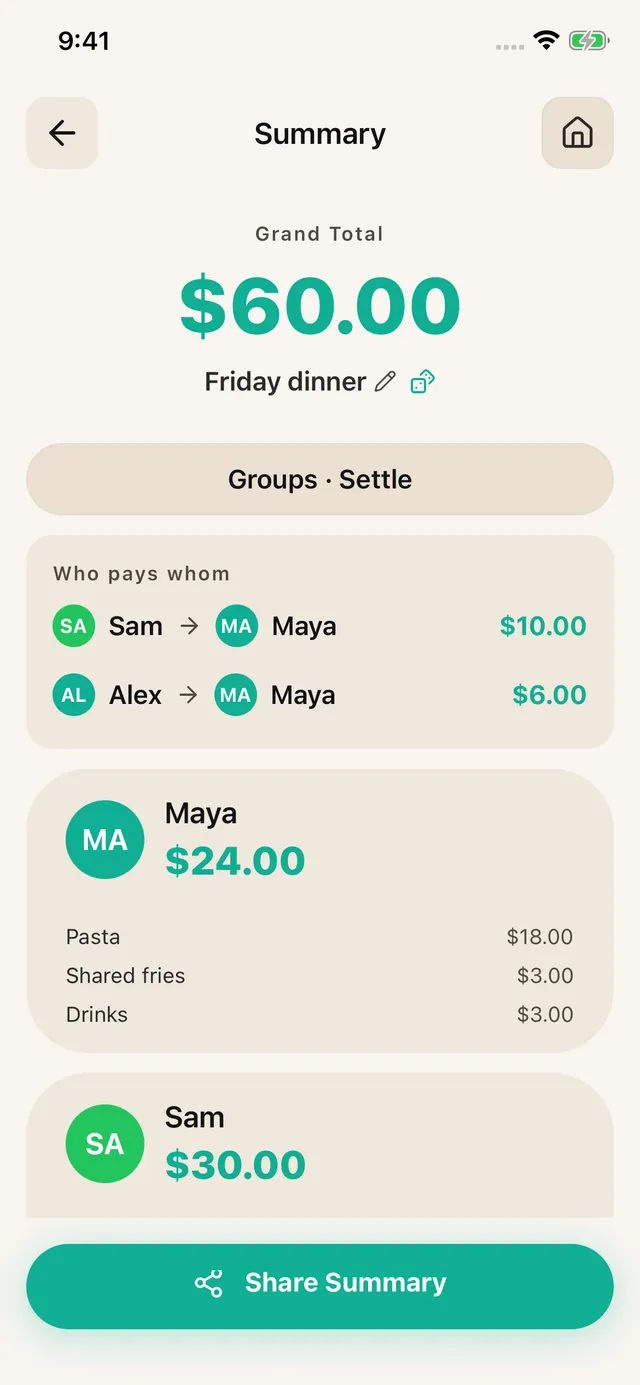
Venmo and Zelle vs Bill-Splitting Apps
Venmo vs bill splitting app: Venmo Groups tracks group expenses, supports custom shares and settlement, while SPLIIT Pro scans and assigns receipt line items; Zelle remains a payment rail.
If your friend group already uses Venmo to pay each other back, downloading another app feels redundant. Venmo Groups exists specifically for shared expenses. Zelle moves money between almost any bank instantly. So the Venmo vs bill splitting app question comes up constantly — and the honest answer depends entirely on what your group is trying to do.
Where Venmo and Zelle Actually Work
Both are excellent at exactly one thing: moving money from one person to another, fast. Someone covers the Uber, you Venmo them $12, done in ten seconds. Zelle is even faster for larger amounts since it goes bank-to-bank with no float delay and no fee on most banks. For a one-off reimbursement between two people, neither Venmo Groups nor a dedicated app beats the simplicity of “just send it.”
Venmo Groups specifically adds a shared expense space where a group can record expenses, set custom shares, see amounts due, mark payments and settle up. See Venmo’s expense-management guide and its official settle-up guide for the current workflow. It is a useful US ledger and payment layer, not a receipt-scanning tool.
Where They Break
The cracks show up the moment a group’s expenses get complicated, which for most friend groups and roommates happens fast.
No receipt line-item extraction. Venmo Groups can track the expense, accept custom shares, calculate amounts due and record payments, but it does not scan a restaurant or grocery receipt and assign each line to the people who ordered it. Dana’s $18 salad and Sam’s $34 steak plus cocktails still need to be entered or calculated elsewhere.
Ledger first, receipt second. If Sam covers dinner Monday and Dana covers drinks Thursday, Venmo Groups can keep those group expenses together and show what is due. The hard part is the detailed receipt calculation before those totals enter the ledger. That is where a receipt-first app helps.
Settlement is not the same as receipt splitting. Venmo can simplify the group’s settlement and mark payments, but it is not a substitute for assigning thirty receipt lines. Use the ledger for the running group record and a receipt calculator for the item-level math.
Zelle has no group feature at all. It’s purely peer-to-peer. There’s no shared ledger, no group request, nothing. For anything beyond “I owe you money, here it is,” Zelle isn’t even trying to solve the group problem — it’s a payment rail, not an expense tracker.
Side-by-Side
| Itemizing | Running balance | Settle-up math | Fees | |
|---|---|---|---|---|
| Venmo (Groups) | No receipt-line scan | Yes, group expenses | Yes, custom shares and settlement | Free for bank/debit funding; 3.00% for credit-card payments; Instant Transfer 1.75% (minimum $0.25, maximum $25) |
| Zelle | No | No | No group feature at all | Free, most banks |
| SPLIIT Pro | Yes, per line item | Private expense groups and balances | No, calculates shares to settle manually | Free to start; Use your payment method to settle |
Choose SPLIIT Pro for itemized receipts, private expense groups and repayment tracking. Choose a collaborative expense app when everybody must edit the same records. SPLIIT Pro does not import another app’s history, convert currencies or transfer money.
Fees Are the Other Quiet Cost
It’s easy to think of Venmo and Zelle as “free,” and mostly they are — bank transfers and debit funding cost nothing on either. Venmo’s current official fee schedule lists a 3.00% fee for credit-card payments and a 1.75% Instant Transfer fee, with a $0.25 minimum and $25 maximum. The distinction matters: Instant Transfer is not the same fee as paying with a credit card. A dedicated splitting app does not touch the actual money movement; It calculates the final number so the group can settle the verified amount through its chosen payment method.
A Real Scenario
A group of four roommates has rent split unevenly by room size, a $210 Costco run split evenly, and a $340 dinner where two people did not drink. Venmo Groups can record the three expenses, accept the custom shares, calculate what each person owes and mark the eventual payments. It still does not read the dinner receipt and decide which person had each item.
The Real Answer
the best Splitwise alternative for 2026 · the best app to split bills with friends
If your group has a chronic problem where the numbers never quite add up — or one person always seems to be owed more than they’re getting back — that’s less an app problem and more a people problem, and no amount of Venmo requests fixes that on their own.