How to Split Airbnb Costs Fairly With Friends
How to split Airbnb cost with friends when rooms and stay lengths differ — comparing by-headcount, by-room, and by-night methods with real numbers.
How to split Airbnb cost with friends gets complicated fast the moment the group isn’t uniform — different room sizes, a couple sharing a bed while everyone else has their own, someone flying in two days late. An even split across everyone sounds simple until you actually look at who’s getting what for their money, and by then someone’s already unpacked in the good room and the conversation feels awkward to have.
Here’s how the three common methods actually play out with real numbers, and which one to default to.
The Three Methods
By headcount. Total cost divided by number of people, full stop. Simplest math, and it’s fine when the group is genuinely uniform — same room quality, same number of nights, nobody sharing a bed with someone else in the split.
By room. The total gets divided across bedrooms first, accounting for size or quality, then split again among whoever’s occupying that room. A couple sharing a room splits that room’s allocated cost between the two of them; Someone with their own room pays their room’s full allocation.
By night. Cost gets divided by total person-nights (people multiplied by nights stayed), so someone who only joins for part of the trip pays proportionally less than someone there for the whole thing.
Most real trips need some combination of these, because real groups have both uneven rooms and uneven stay lengths at the same time.
Worked Example: $1,600 Airbnb, Uneven Everything
Here’s a realistic case: a $1,600 total Airbnb (four nights, three bedrooms). Six people total. Two of the bedrooms are similar mid-size rooms with one person each. The third is the primary suite, occupied by a couple sharing it. One additional person — call them the seventh — joins for only 2 of the 4 nights, sleeping on a pullout in the living room.
Method 1: By headcount, ignoring nuance. $1,600 divided by 7 people = $228.57 each. Simple, but it treats the person who stayed 2 nights the same as everyone who stayed all 4, and it treats the couple sharing a room and splitting their cost between two people the same as someone with a private room to themselves. This is the version that generates quiet complaints afterward — usually from whoever feels shorted, and usually after the trip, when it’s harder to fix.
Method 2: By room, then by night for the partial stay. First, pull the pullout-couch person out and charge them separately by night: their fair share, at a discount for the couch versus a bedroom, might be set at half of what a full bedroom occupant pays per night. Say that works out to $114 total for their 2 nights. That leaves $1,486 to split across the three bedrooms and the six people in them for 4 nights.
If the two mid-size rooms are valued equally and the primary suite (with the ensuite bath) is valued at 1.5x a mid-size room: that’s 2 + 2 + 1.5 = 5.5 “room units” across the three bedrooms. Each unit is worth $1,486 / 5.5 = $270.18. So each mid-size room owes $540.36, split by the one person in it — $540.36 each. The primary suite owes $405.27, split between the couple — $202.64 each.
Final numbers: two solo mid-size room occupants pay $540.36 each, the couple pays $202.64 each, and the couch person pays $114 total. That’s a real spread — the mid-size room occupants are paying more than double what half the couple pays — but it reflects reality: they each have a private room for the full trip, the couple is sharing one room between two people, and the couch person was there half as long in a much lower-value spot.
Which One to Recommend
By-night-and-room is more accurate, but it’s also more math, and for a group of close friends on a casual trip, that precision can feel like overkill. The honest recommendation: use by-headcount only when the group is genuinely uniform — same rooms, same nights, nobody sharing. The moment any of those three things is uneven, the extra ten minutes of room-and-night math is worth it, because that’s exactly the scenario where an even split quietly shortchanges someone and they notice, even if they don’t say anything.
If your group’s situation is closer to the room-size question specifically — say a shared house rather than an Airbnb — split rent by room size fairly has more detail on valuing rooms against each other.
Don’t Forget the Fees on Top
Whichever method you use, apply it to the total checkout price, not the nightly rate. Cleaning fees, service fees, and taxes routinely add 15-25% on top of what the listing advertises, and if you split the nightly rate and forget the rest, whoever booked is quietly eating that difference. The cleanest rule: split cleaning and service fees evenly across everyone regardless of room or night count, since those costs don’t scale with room quality — everyone dirtied the place roughly the same amount.
Making the Math Easy to Trust
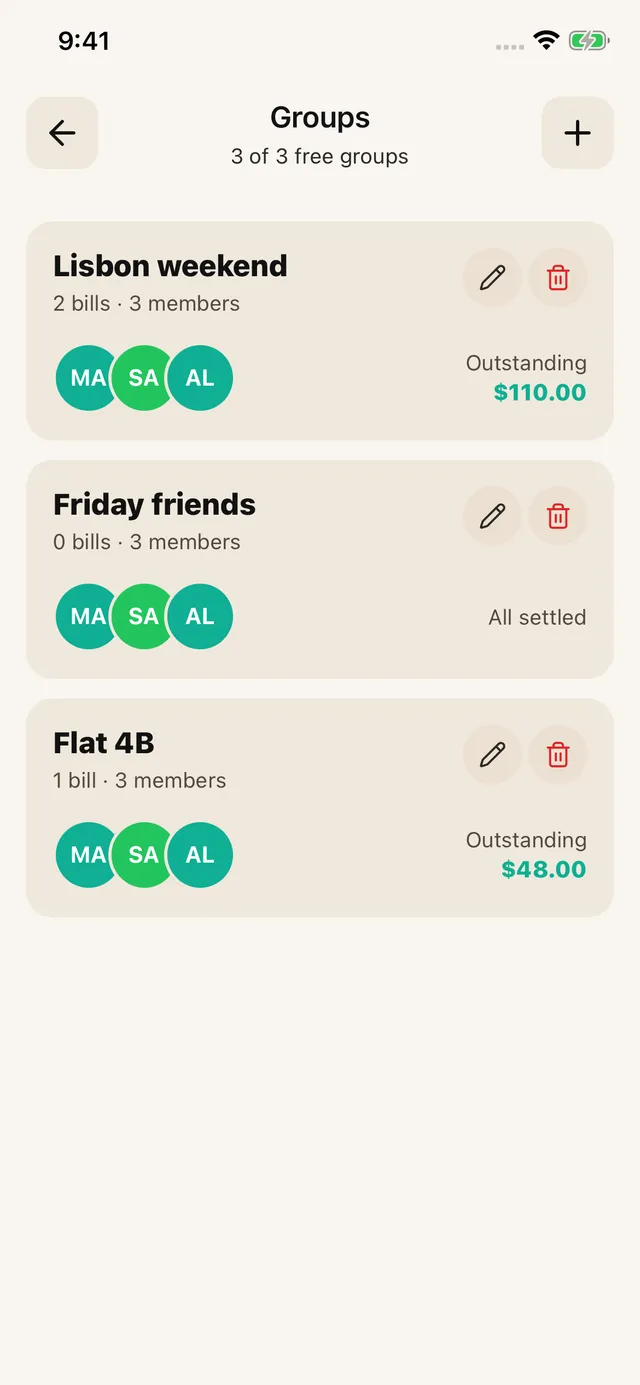
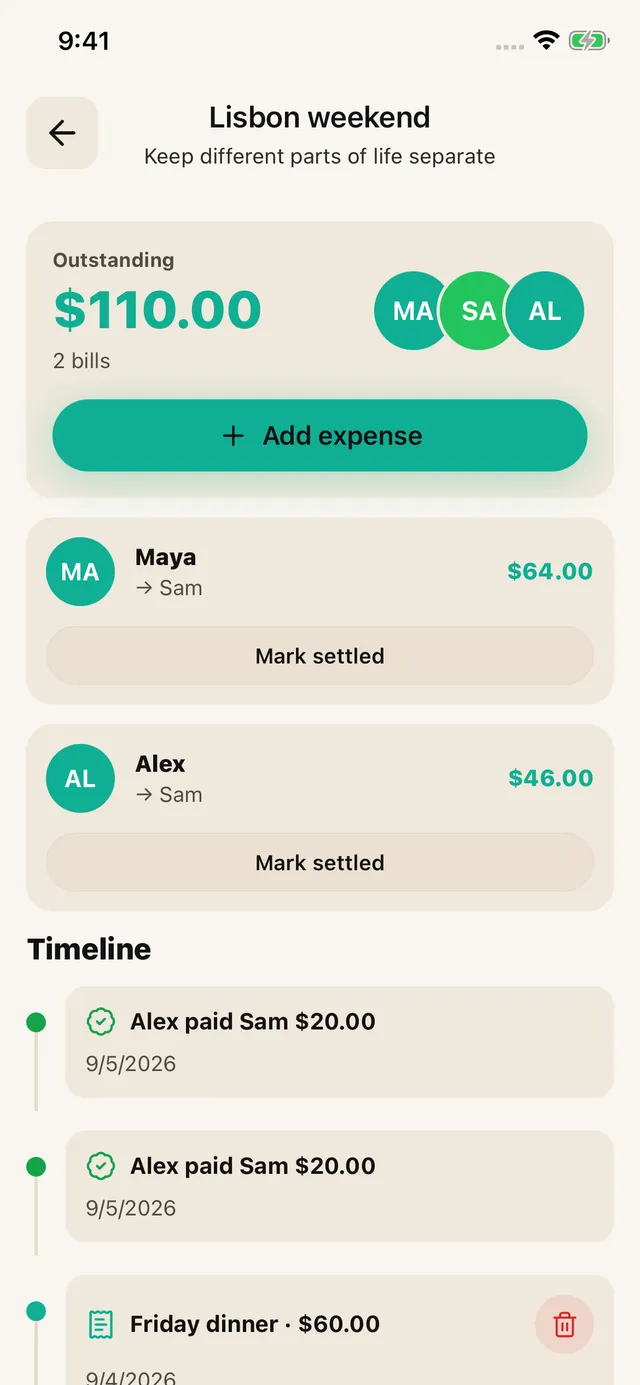
SPLIIT Pro: create a trip group and add each expense with its actual payer and participants. Leave skipped activities off that person’s share. Open the group to review the bill and settlement timeline. Keep balances in separate currencies; no exchange-rate conversion is applied.
For the rest of the trip’s expenses beyond just the rental — food, transport, activities — how to split group travel expenses without chaos covers the full workflow, and if the trip crosses borders, multi-currency group trip expenses covers what changes when payments aren’t all in the same currency.
Agree Before Anyone Claims a Room
The method matters less than the timing. Decide how you’re splitting before anyone picks a bedroom, not after — once someone’s settled into the primary suite, asking them to pay a premium feels like a penalty instead of a fair adjustment. Do the math up front, screenshot the final checkout total so nobody’s guessing at fees, and the only thing left to argue about on the trip is who forgot to buy more coffee.
If the rental includes a long itemized receipt for groceries or supplies, SPLIIT Pro can scan and divide that one receipt on iOS or Android.