How to Split Group Travel Expenses Without Chaos
A group trip expense app plus the rules that prevent post-trip money fights: one shared group, same-day logging, and one settle-up at the end.
A group trip expense app only solves half the problem. The other half is the group actually using it consistently, which is where most trips fall apart — not because nobody wanted to track expenses, but because by day three everyone’s tired, the group chat has forty unread messages, and nobody remembers who paid for the second round of tacos. If you’re planning a spring-break trip on a tight budget with five roommates, or a bigger group trip with more disposable income, the failure mode is the same: money gets fuzzy exactly when everyone’s having the most fun and paying the least attention.
Here’s the workflow that actually prevents the post-trip reconciliation fight, plus a worked example with real numbers.
The Rules That Prevent Money Fights
Four rules, agreed before anyone books anything:
- One shared group, not a scatter of side payments. Every trip expense goes into the same place, whether that’s an app or a shared note. The moment someone starts a side thread — “I’ll just Venmo you separately for the gas” — the group loses the single source of truth, and single source of truth is the entire point.
- Log the same day you pay. Not at the end of the trip. Same day, ideally within an hour while the receipt is still in your hand. Memory degrades fast on a trip where every day looks different from the last.
- Decide the base currency (or just the base habit) up front. Even for domestic trips, decide whether tips get included, whether split rounds up or down, and who’s tracking it. For international trips this matters even more — see the multi-currency splitting guide for the full mechanics.
- One settle-up at the end, not a dozen small reimbursements mid-trip. Constant Venmo-ing during the trip creates its own tracking mess. Let the balances net out and settle once, at the end, in one clean batch of transfers.
If your group skips rule one — everyone tracking their own thing “to make it easier” — you end up with five partial records and no complete picture. That’s worse than no tracking at all, because everyone thinks the math is handled somewhere.
The Budget Trip Version of This Problem
If you’re a group of college friends or recent grads doing a budget trip — a shared Airbnb, cheap flights, cooking half your meals — the stakes per dollar are actually higher, not lower. A $12 discrepancy matters more to someone stretching a trip on a tight budget than a $50 discrepancy does on a trip where everyone’s got room to spare. Don’t assume a lower-budget trip needs less rigor around tracking. If anything it needs more, because nobody has the slack to shrug off being shorted $20.
Worked Example: 5 Friends, 6 Days, About 40 Expenses
Take a real-sized trip: five friends, six days, roughly 40 separate expenses ranging from a $6 coffee to a $340 group dinner. Two people front more than the others because their cards had better rewards or lower foreign transaction fees.
By the end of the trip, the raw numbers look like this:
- Person A paid $890 total across lodging and a couple of group dinners
- Person B paid $610, mostly transport and groceries
- Person C paid $340
- Person D paid $210
- Person E paid $150
Total spent: $2,200. Split five ways evenly (assuming everyone participated equally in everything, which is the simplifying case): each person’s fair share is $440.
That means:
- Person A is owed $450 (paid $890, owes $440, net +$450)
- Person B is owed $170 (paid $610, owes $440, net +$170)
- Person C is owed nothing further, roughly at par ($340 paid vs $440 owed, so actually owes $100)
- Person D owes $230 ($210 paid vs $440 owed)
- Person E owes $290 ($150 paid vs $440 owed)
Without netting, that’s a mess of individual reimbursements — D and E paying back A and B in some combination nobody wants to work out by hand. This is where a group trip expense app earns its keep: instead of five people sending each other money in every direction, the app calculates the minimum number of transfers needed to zero everyone out. In this case, it collapses to four transfers: E pays A $290, D pays A $160, D pays B $70, and C pays B $100. Four rather than three, because no combination of the three debts adds up to exactly the $170 B is owed — which is precisely the kind of thing nobody works out correctly at the airport. Same result, a fraction of the transactions.
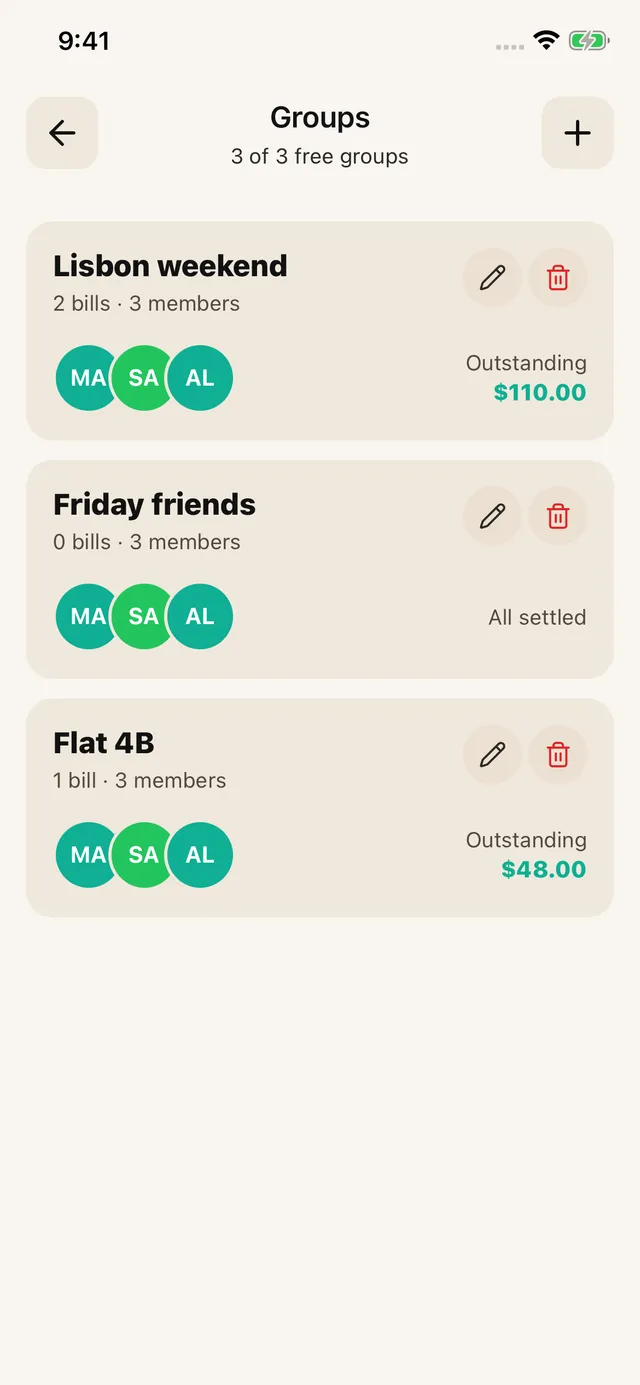
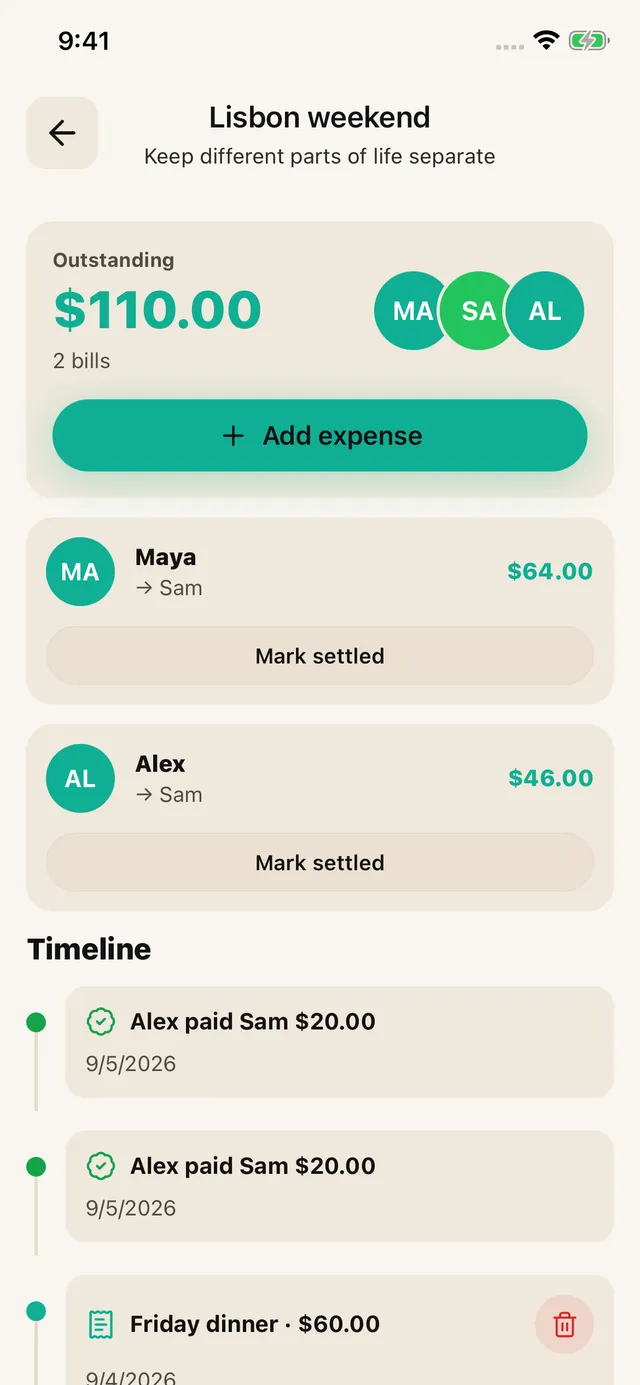
SPLIIT Pro: create a trip group and add each expense with its actual payer and participants. Leave skipped activities off that person’s share. Open the group to review the bill and settlement timeline. Keep balances in separate currencies; no exchange-rate conversion is applied.
What a Group Trip Expense App Can’t Decide for You
An app won’t decide for you whether someone who skipped the paid tour should still split its cost, or whether the group covers a friend who’s tighter on money this month. Those are judgment calls, and they go smoother when you make them out loud in the moment rather than silently adjusting the numbers and hoping nobody notices. If two people opt out of an activity, exclude them from that specific expense rather than defaulting everything to an even split — itemizing correctly is what makes the final settle-up feel fair instead of just convenient.
Trip-Specific Playbooks
Different trip types have their own wrinkles. If you’re staying in a shared rental, how to split Airbnb costs with friends covers room-value differences and cleaning fees. If you’re driving instead of flying, road trip cost splitting handles gas, tolls, and uneven driving shifts. And if you want an app that does this without asking for a monthly fee, best app to split bills without a subscription breaks down what to look for.
The Last Night Matters More Than the First
Most of the money-related tension on group trips doesn’t happen because someone was cheap. It happens because nobody agreed on the process, so by the last night everyone’s tired and the numbers feel opaque. Handle the settle-up on the last evening, not at the airport the next morning, while everyone’s still together and can actually resolve a discrepancy face to face instead of over a group chat three time zones apart.
If you want the logging and the netting handled automatically instead of chasing receipts after the fact, SPLIIT scans them, splits them, and tells everyone their share before you’ve even left the restaurant. It’s free on iOS and Android.