How to Split a Restaurant Bill Fairly
A split restaurant bill app makes this easy, but here's how to split a restaurant bill fairly by hand too — even vs. Itemized, with a real $147 dinner worked out.
The check lands face-down in the middle of the table and six people simultaneously find something interesting to look at on their phones. This is the moment a split restaurant bill app earns its keep, but even without one, there’s a right way and a wrong way to divide a group dinner — and most people default to the wrong way because it’s less awkward in the moment, even though it’s less fair.
The wrong way is splitting evenly no matter what anyone ordered. It’s fast, nobody has to do math out loud, and it quietly overcharges the person who had tap water while undercharging the person who had three cocktails. Whether that matters depends entirely on the group and the gap.
A Real Example: The $147 Dinner
Dana and Sam go out with two friends. The bill: $147 before tax and tip. Dana had three cocktails ($36) plus an entree ($24) — $60 total. Sam had tap water and split an appetizer ($8) plus a $14 entree — $22 total. The other two friends ordered pretty similarly to each other, at roughly $32.50 each.
Even split: $147 ÷ 4 = $36.75 per person, before tax and tip. Dana pays $36.75 for $60 of food and drinks — a $23 discount. Sam pays $36.75 for $22 worth — nearly $15 more than they actually ordered.
Itemized split: Each person pays for what they ordered. Dana: $60. Sam: $22. The other two: $32.50 each. That adds to $147 exactly. Now add 8% tax and 20% tip (28% total, a common shorthand): multiply each person’s share by 1.28.
- Dana: $60 × 1.28 = $76.80
- Sam: $22 × 1.28 = $28.16
- Friend 3: $32.50 × 1.28 = $41.60
- Friend 4: $32.50 × 1.28 = $41.60
Total: $188.16, which checks out against $147 × 1.28. Sam pays about $8.60 less than the even split; Dana pays about $16.80 more. That’s the real cost of “fair” — someone’s going to notice the difference, and for a group that drinks unevenly, it’s usually worth noticing.
Even, Itemized, or Proportional: The Honest Tradeoffs
Even split. Fast, zero awkwardness, works great when everyone ordered roughly the same thing. Falls apart the moment drinks or apps create a real cost gap — it quietly subsidizes the biggest spender at everyone else’s expense.
Itemized split. Exactly fair to the dollar. The cost is friction: someone has to go through the receipt, assign items, and do the math, which is exactly the tedious part a split restaurant bill app is good at — scan the receipt, drag items to names, done. Without an app, it’s a five-minute negotiation nobody enjoys at the table.
Proportional split. Instead of itemizing every bite, split by rough spend tier — “big orders” pay more, “light orders” pay less, without going item by item. Faster than full itemization, fairer than a flat even split, but it requires the group to agree on the categories, which can itself be its own small negotiation.
If your group lands on itemizing more often than not, this is the one part worth automating. Snap the receipt with SPLIIT and the line items, tax, and tip get assigned and prorated while everyone’s still finishing dessert — free on iOS and Android, and it beats being the friend hunched over the receipt with a calculator.
The Bar Tab Problem
Restaurant splitting gets its dumber cousin at the bar: rounds. If everyone buys a round in turn, it roughly evens out over a long night — but “roughly” breaks down fast if the group has 5 people and only does 3 rounds before people start peeling off, or if one person only had a single drink and doesn’t want to buy a $60 round for people who’ve already left. The fairest fix for uneven group sizes or uneven drinking is the same as dinner: track who actually ordered what, rather than assuming rounds will average out. It usually doesn’t, and the person who drinks the least is almost always the one who ends up overpaying.
So How Should You Split the Restaurant Bill?
For casual dinners where everyone orders similarly — burgers, similar drink counts, nobody’s the outlier — just split evenly and move on. The math isn’t worth the social cost of itemizing a $12 difference. One more low-effort option: ask the server for separate checks before anyone orders. Plenty of restaurants will do it for groups under six or so, and it makes the whole question disappear, though big parties and busy nights often get a flat no. For dinners with a real spread, especially ones involving alcohol, itemizing is worth the extra two minutes, and it’s the difference between Sam quietly resenting these dinners and Sam actually wanting to come next time.
This is the exact problem SPLIIT is built around: take a photo of the receipt, its AI reads the line items, you drag each one to whoever ordered it, and it prorates tax and tip automatically across the group — no one has to be the designated bill-math person at the table. It’s free on iOS and Android.
If you’re trying to avoid a monthly fee for something this simple, see the best app to split bills without a subscription. And if the real issue in your group isn’t restaurant math but recurring gaps in what people can afford to spend, splitting costs when friends have different incomes is the more useful read.
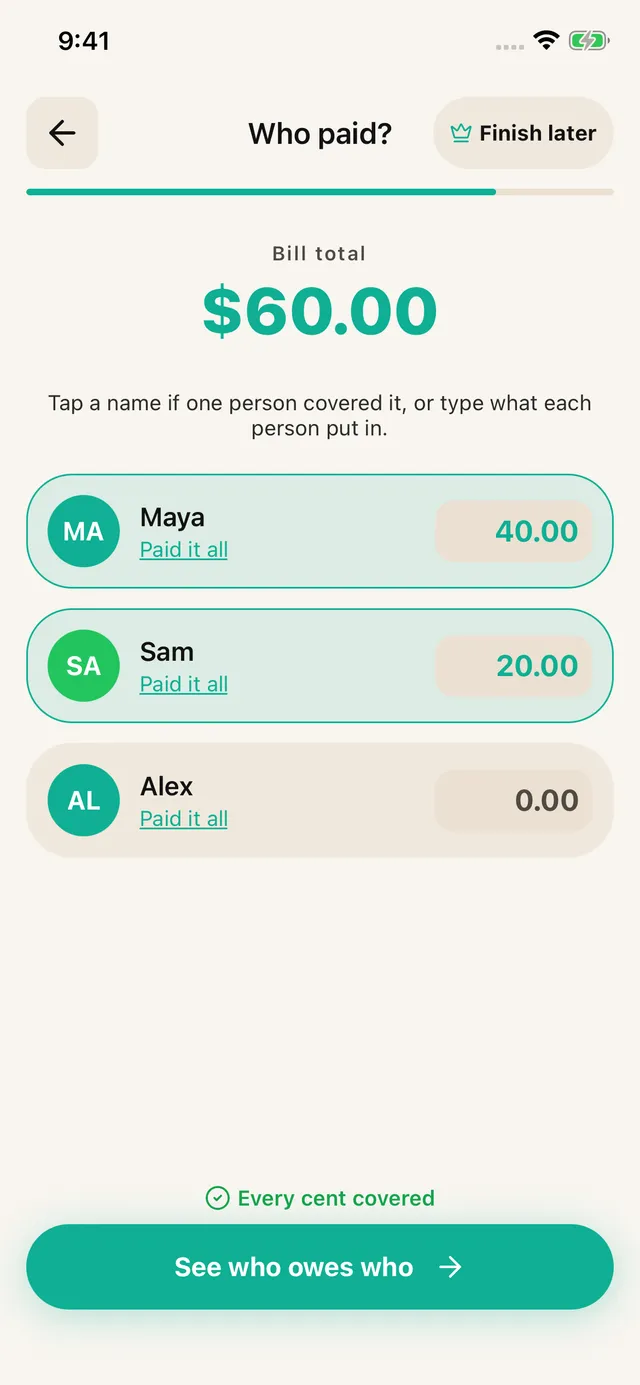
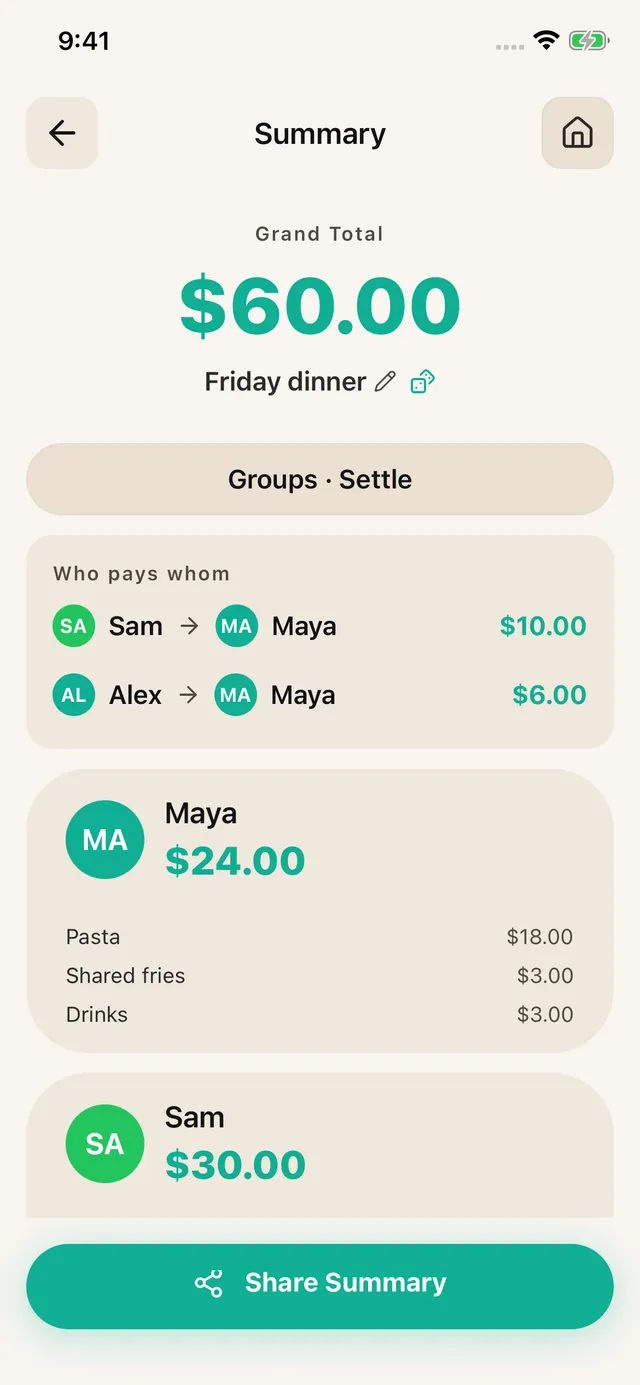
SPLIIT Pro: Assign the salad to you and the steak to the people who ate it. Share the appetizer only with those who joined in. Enter who covered the check, then share the suggested repayments. The app calculates; It does not move money.