How to Split Road Trip Costs: Gas, Hotels, and Food
How to split road trip costs fairly between gas, hotels, and food — with a real gas math example and an honest take on tracking small stuff.
Four people, one car, 1,200 miles. Before anyone’s even packed a bag, someone needs to figure out how to split road trip costs so the person driving doesn’t end up $300 poorer than everyone else by the time you’re back. Gas is the obvious one. Hotels and food are where it actually gets complicated, because unlike gas, they don’t split evenly by default — someone always orders the $22 entree while someone else grabs a gas station sandwich.
Road trips are deceptively hard to split fairly because the costs arrive in three different rhythms: gas is periodic and shared equally, hotels are periodic and shared equally (usually), and food is constant and wildly uneven. Treating all three the same way is where trips go sideways.
The Gas Math, Worked Out
Say you’re driving 1,200 miles round trip, the car gets 30 mpg, and gas is running about $3.50 a gallon. Four people are splitting it.
- Gallons needed: 1,200 ÷ 30 = 40 gallons
- Total gas cost: 40 × $3.50 = $140
- Per person: $140 ÷ 4 = $35
That’s the easy part. The harder question is whether $35 each is actually fair, because the car owner isn’t just buying gas — they’re putting 1,200 miles of wear on their own vehicle. Oil changes, tire wear, brake pads, depreciation. The IRS’s standard mileage rate (used for business deductions) sits around 67 cents a mile as of this writing, and while nobody expects road-trip friends to pay that, it signals that “just gas” undercounts the real cost of driving your own car.
Two reasonable fixes: a flat per-mile rate that’s lower than the IRS figure — say 10–15 cents a mile split among the passengers, which on a 1,200-mile trip works out to $120–180 total, or roughly $30–45 per passenger on top of gas — or a simpler flat stipend, like everyone chips in an extra $20 to the driver regardless of mileage. Neither is scientifically “correct.” Both beat the driver eating the wear-and-tear silently and feeling weird about lending the car next time.
Hotels: Split by Room, Not by Person (Usually)
If everyone’s splitting rooms two to a bed, hotels are simple: total cost divided by the group. Where it gets messy is when someone wants their own room, or when one person books ahead on points and the group owes them cash instead. Log it as one expense per hotel stay and split it evenly among whoever’s actually staying there — don’t make the person who booked on points chase four separate reimbursements from memory three weeks later.
Food: Where Even-Splitting Breaks Down
This is the category people get wrong. Splitting every restaurant bill evenly sounds fair until you notice one person orders a side salad and water while another gets the ribeye and two beers, every single meal, for four days. Over a long trip that gap compounds into real money.
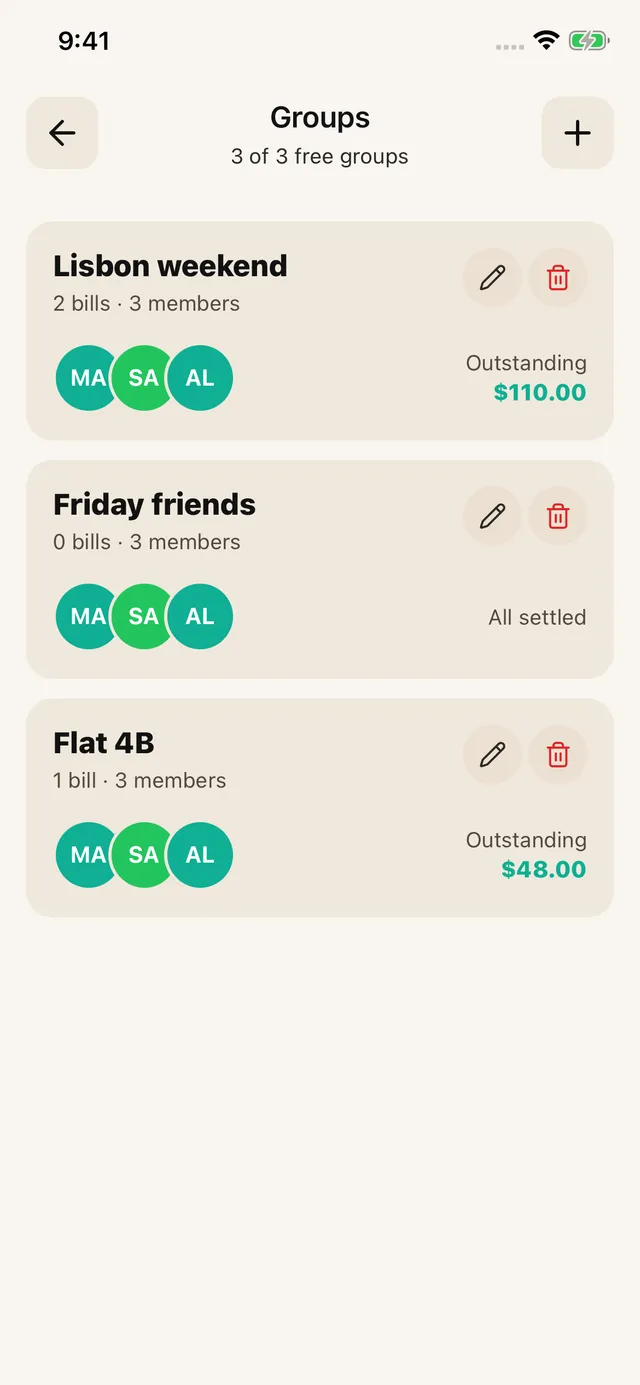
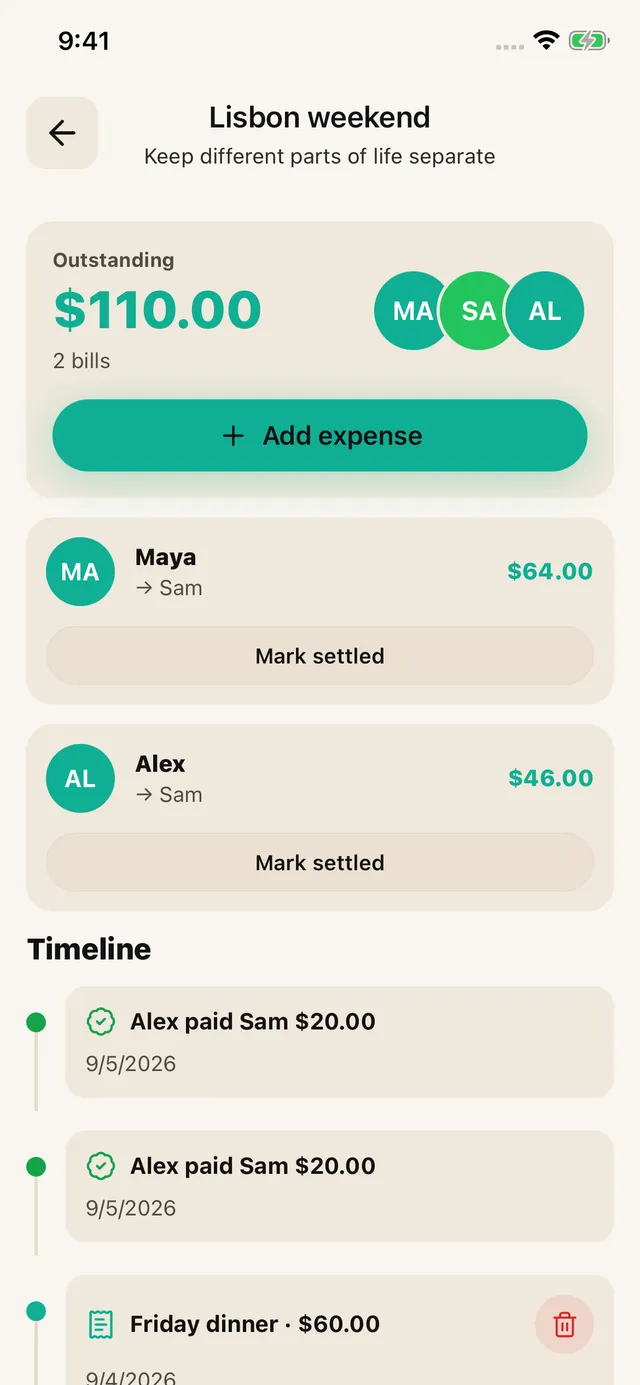
SPLIIT Pro: create a trip group and add each expense with its actual payer and participants. Leave skipped activities off that person’s share. Open the group to review the bill and settlement timeline. Keep balances in separate currencies; no exchange-rate conversion is applied.
The Honest Take: Should You Track the $6 Snacks?
No. Not really. If you’re tracking every gas station coffee and vending machine snack, you’re spending more energy on bookkeeping than the money is worth, and you’ll annoy your friends in the process. The stuff worth tracking is anything over roughly $15–20 or anything that’s clearly unequal — a hotel room, a tank of gas, a big group dinner. Small individual purchases (your own snacks, your own coffee) are simplest left as “everyone pays for their own.” Trying to itemize a bag of chips is how road trips turn into spreadsheet arguments nobody wanted.
Putting It Together
A four-person, four-day road trip with the numbers above might look like: $140 gas plus a $60 wear-and-tear contribution to the driver ($200 total, $50/person), $320 in hotels split evenly ($80/person), and food handled per-meal (either even splits for casual meals or itemized for anything with a big spread). Write the framework down before you leave — who pays for what, how gas and wear-and-tear get handled, whether food is itemized or split — so nobody’s negotiating fairness while standing in a gas station parking lot at 2am.
For more on managing costs across a longer group trip, see how to split group travel expenses without chaos. If part of your trip involves a shared rental, how to split Airbnb costs with friends covers that specific wrinkle. And if you just want a simple way to track it all without paying for another subscription, the best app to split bills without a subscription is worth a look before the trip starts, not after.