How to Split Rent and Utilities With Roommates Without Fights
The best app to split rent and utilities with roommates, plus scripts for the awkward money talks and a real worked example for three roommates.
Every roommate house has one person who ends up tracking everything: who paid the internet bill, who owes for the toilet paper run, who’s three days late on Venmo again. If that’s you, you don’t need a lecture about communication. You need an app to split rent and utilities with roommates that does the math so nobody has to have the same conversation twice a month.
The actual problem isn’t the money. It’s that rent, electricity, gas, internet, and the random Costco run all live in different places — a group chat, someone’s Venmo history, a sticky note on the fridge — and nobody has the full picture except the person doing the chasing. That person burns out. Then the fights start, usually not about the amount owed but about the fact that it took three reminders to get it.
Why an app to split rent and utilities with roommates beats a group chat
The best time to agree on how bills get split is move-in week, before anyone’s annoyed about anything. Decide who “owns” which recurring bill (one person’s name on internet, another on gas), and agree that every payment gets logged somewhere all three of you can see, not just remembered. A shared expense tracker beats a group chat because a group chat has no running total; You can scroll for ten minutes and still not know who’s ahead.
This is also where you set defaults: rent split evenly or by room size, utilities split evenly or weighted for whoever’s home all day, and how you’re handling groceries, together or separate. If you’re moving in with people for the first time, it’s worth reading through a full list of money rules to set before you sign the lease, because the rules are much easier to agree on before there’s a real bill sitting between you.
A worked example: three roommates, one month
Say rent is $2,700 split evenly ($900 each), plus a $180 electric bill, a $70 gas bill, and a $75 internet bill, all split evenly too, so $108.33 per person on utilities. One roommate, Priya, also fronted $140 for a Costco run of shared staples (paper towels, coffee, cleaning supplies), split three ways at $46.67 each.
- Person A owes: $900 rent + $108.33 utilities + $46.67 groceries = $1,055
- Person B owes: same = $1,055
- Person C (paid the Costco run): owes $900 + $108.33 = $1,008.33, but is owed $93.34 back from A and B for the groceries
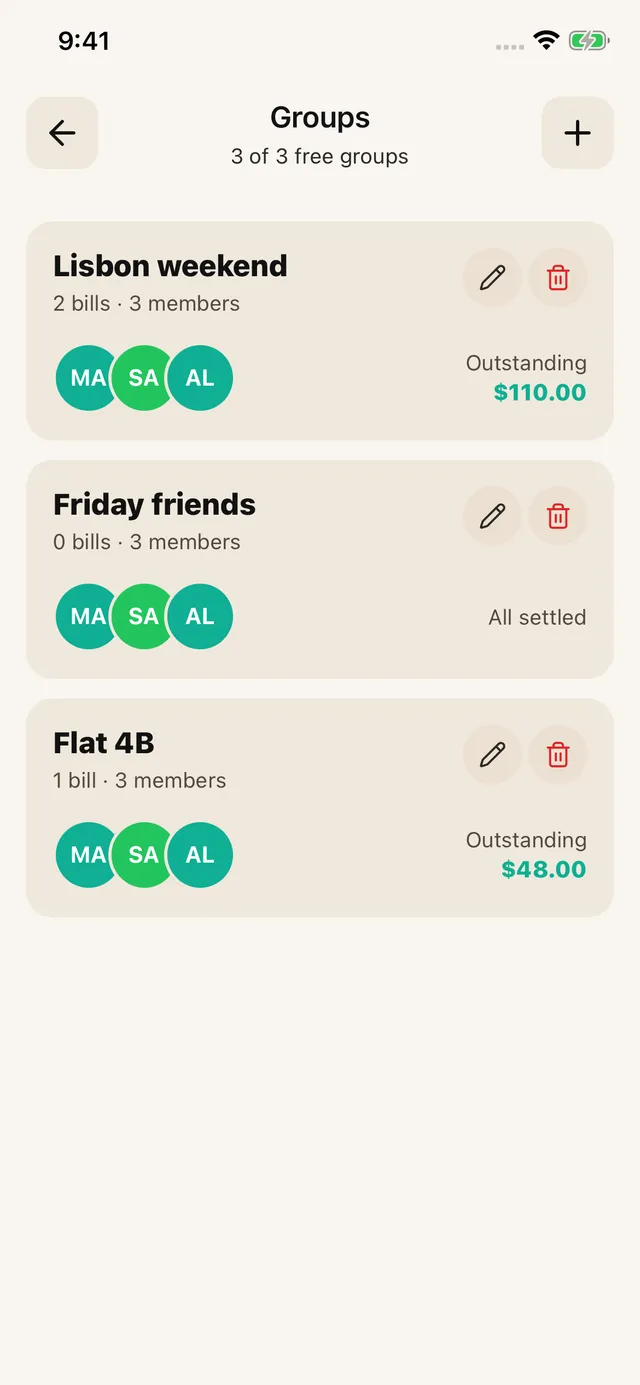
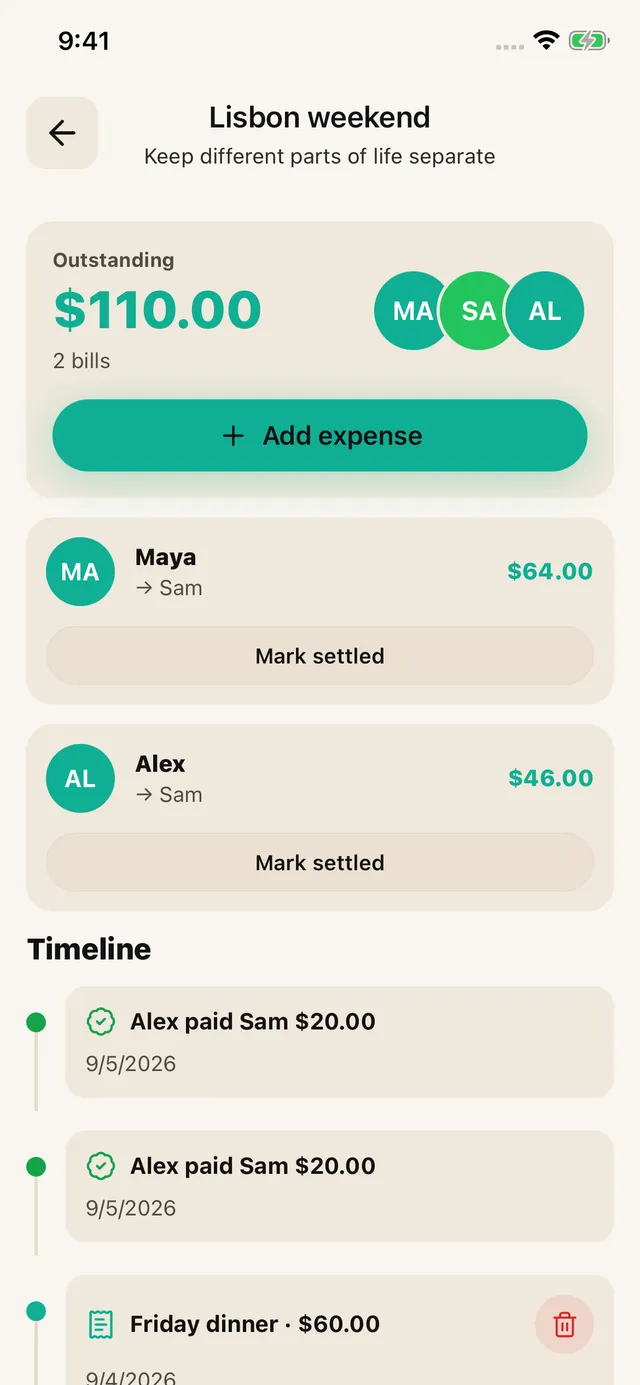
SPLIIT Pro: Assign household items to the household and personal items to their owner. Keep home expenses together in a roommate group. Record a partial repayment in the group, or use Debts for eligible ungrouped bills you paid. Add each new bill yourself; Expenses are not created automatically.
Pick a settlement rhythm, not just a split
A split percentage tells you how much each person owes. It doesn’t tell you when they actually pay it, and that gap is where most of the tension lives. Some households settle every bill the day it comes in; Others let balances ride and settle once a month. Both work, but only if everyone agrees which one you’re doing.
Monthly settlement is easier to manage but riskier: if someone’s genuinely tight on cash by the third week, a $150 lump sum feels like a crisis instead of a routine transfer. Per-bill settlement (pay your share within 48 hours of a bill being logged) keeps amounts smaller and more predictable, at the cost of a few more transactions. Most three- and four-person households land somewhere in between: settle rent immediately since it’s due on a fixed date, and let smaller shared costs like groceries or household supplies accumulate and settle once every week or two.
Whatever you pick, write it down somewhere all of you can see, not just agree to verbally in the kitchen one night. “We settle utilities by the 5th, groceries every Sunday” is a rule. A vague nod during move-in week is not, and six weeks later nobody will remember whose version of the agreement is the real one.
The conversations you actually have to have
No app fixes a roommate who’s genuinely avoiding paying. For that, you need words, and most people freeze up because they don’t know how to start. Two scripts that work.
Asking a roommate to pay their late share: “Hey, I noticed you’re still showing $108 owed on utilities from last month. Can you send that over today or tomorrow? I need to have the full amount ready when the bill’s due on the 5th.”
Specific number, specific deadline, no accusation. It reads as a logistics message, not a confrontation, which makes it easy to answer without getting defensive.
Proposing a system when you move in: “Before we get busy and forget, can we agree on how we’re splitting bills? I was thinking rent evenly, utilities evenly, and we log everything in an app so nobody has to keep it in their head. Sound good, or do you want to do it differently?”
Asking “sound good, or do you want to do it differently” matters. It invites pushback now, while it’s cheap, instead of three months in when someone’s already annoyed.
Where the system still breaks down
Even with a tracker, a few things cause friction that no app solves on its own. Guests who eat the shared groceries. One roommate who buys separately because of dietary needs — see the honest breakdown in how to split groceries fairly for how other households handle that split. And the roommate who pays late every single time, which is a boundaries problem, not a math problem. An app just makes it undeniable instead of debatable.
None of this requires a group meeting or a shared spreadsheet everyone forgets to update. It requires one place where the numbers live, and two short conversations you have once, not every month.