How to Split a Food Delivery Order With Friends
Split Uber Eats, DoorDash, Deliveroo, Glovo, or other group orders by item, then divide discounts, delivery fees, tax, and tip without guessing.
Learning how to split a food delivery order with friends becomes surprisingly difficult once the app adds a coupon, delivery fee, service fee, tax, and tip. The food itself is usually obvious. The bottom third of the receipt is where fairness disappears.
Use one rule consistently: personal items belong to the person who ordered them, shared food belongs only to the people who ate it, and order-wide adjustments follow each person’s food subtotal unless the group agreed otherwise.
Worked example: a $132.30 group order
Four friends order:
- Dana: curry, $22
- Sam: burger and shake, $27
- Noor: salad, $16
- Alex: two entrees, $34
- Shared appetizer for Dana, Sam, and Alex: $15
Food subtotal: $114.
The app applies a $12 order-wide coupon, then adds a $7 delivery fee, $6 service fee, $7.30 tax, and $10 tip. Final total: $132.30.
First assign the appetizer: $5 each to Dana, Sam, and Alex. Food subtotals become Dana $27, Sam $32, Noor $16, and Alex $39. Those shares add back to $114.
The $12 coupon is proportional. Dana receives $2.84, Sam $3.37, Noor $1.68, and Alex $4.11. Use the same proportions for tax and the order-wide fees. The group can decide to divide delivery equally, but proportional allocation is more consistent when one order is more than twice another.
Scan the screenshot instead of typing it
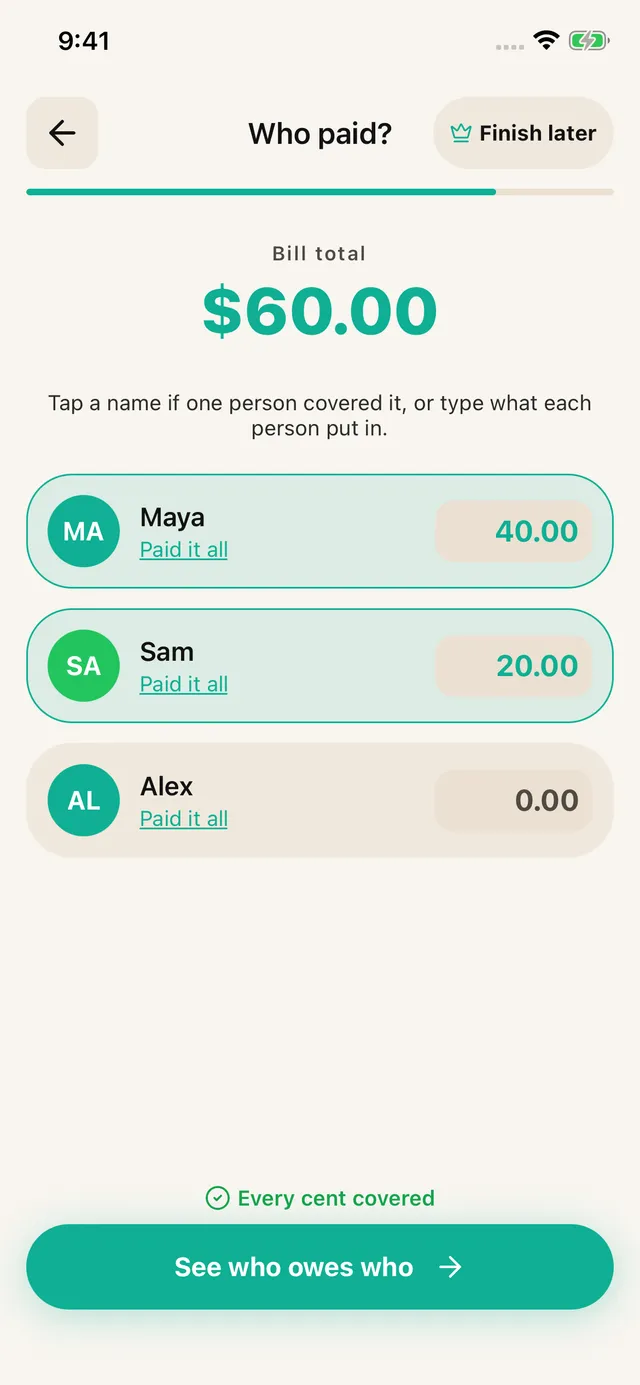
Digital receipts are often easier to read than paper. Screenshot the order summary, crop out unrelated screen elements, and scan it in SPLIIT Pro. Assign the meals, mark the appetizer as shared, and review the coupon and fee lines before confirming.
The free tier allows 7 saved contacts plus you and 3 groups. Scans refill over time. Pro removes ads and adds unlimited scans, contacts and groups, plus drafts. Past transactions remain readable for everyone.
Handle discounts before fees
Discount order matters because some apps calculate tax or service fees after a coupon and others do not. Use the numbers on the final receipt rather than reconstructing what the platform should have done.
- Item discount: give it to that item’s owner.
- Buy-one-get-one offer: assign both items and the discount to the people sharing the offer.
- Percentage coupon: allocate by eligible subtotal.
- Fixed account credit: decide whether it belongs to the account holder or the group before applying it.
There is no universal moral answer for a personal account credit. There is a clear process answer: agree, then document the rule.
What not to do
Do not split the final total equally unless the orders are genuinely similar. Do not make the account holder absorb every fee simply because the order used their phone. Do not allocate a shared appetizer to someone who did not eat it. And do not send four rounded payment requests that no longer add back to the receipt.
Verdict
Assign food first, apply discounts next, and allocate tax, tip, and order-wide fees last. Check that the shares add exactly to the charged total before requesting money.
The same method works for a paper restaurant check; See how to split a restaurant bill fairly and our guide to scanning receipts into line items.
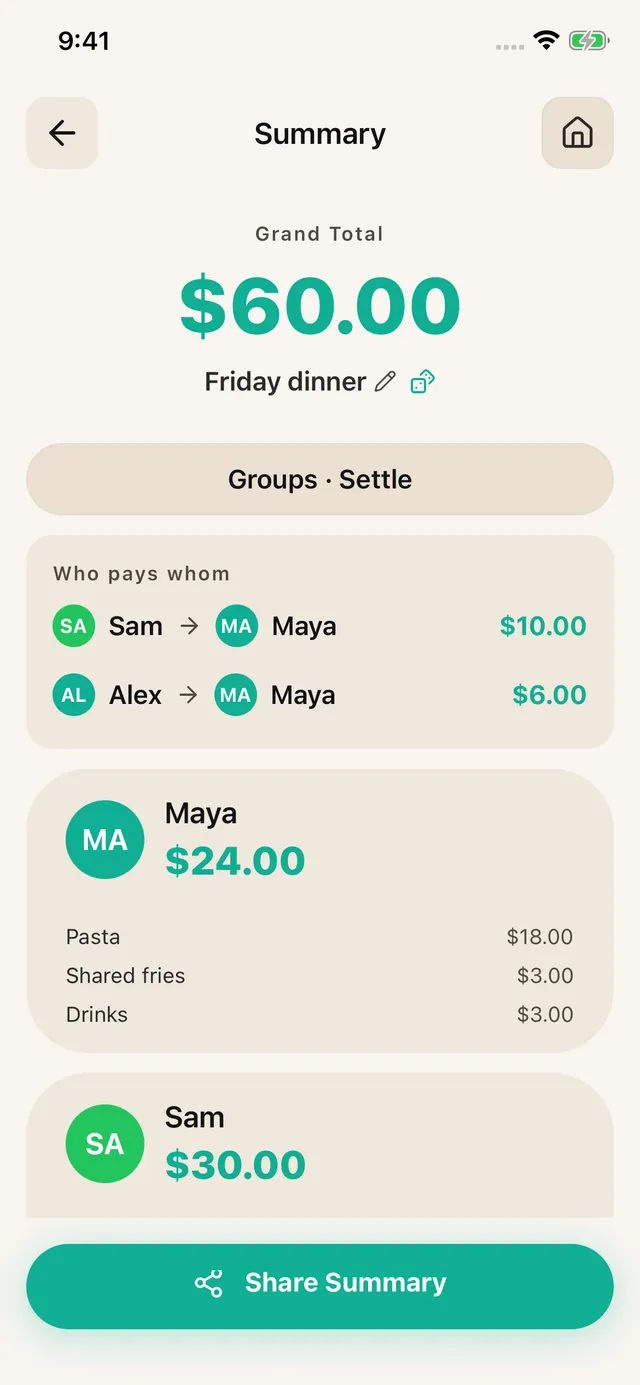
SPLIIT Pro: Upload the delivery screenshot and check the final discounts and fee lines. Assign each meal and any shared sides. Share the itemized amounts. Record the payer and use collection reminders to check unpaid shares later. Reminders come to you.
Frequently asked questions
How should friends split a food delivery fee?
Divide the delivery fee equally when everyone caused roughly the same order cost, or proportionally by food subtotal when orders differ greatly. State the rule before calculating. A person with a $10 meal should not automatically pay the same fee share as someone with a $45 order.
How do you split a delivery discount fairly?
Apply item-specific discounts to the item that earned them. Divide order-wide percentage discounts proportionally by each person's eligible food subtotal. Divide a fixed coupon proportionally unless the group agreed that the coupon belongs to the account holder.
Can SPLIIT Pro scan a digital food delivery receipt?
Yes. Take a screenshot of the order receipt and scan it like a paper receipt. Review the extracted lines, assign each item, then confirm how the app represented discounts and fees before sharing the final totals.