How to Split Tax, Tip, and Service Charges Fairly
Split tax, tip, service charges, discounts, and rounding fairly when people ordered different amounts, with formulas and a worked restaurant example.
The fairest way to split tax, tip, and service charges is to make them follow what each person ordered. Dividing the food by item and then dividing every fee equally defeats the reason for itemizing the bill.
The formula is simple:
person's fee share = person's item subtotal ÷ group item subtotal × total fee
Use it separately for tax, tip, service charge, delivery fee, or any other order-wide amount.
Worked example: $180 before fees
Four people have item subtotals of $24, $36, $48, and $72. Together they equal $180.
The receipt adds:
- Tax: $14.40
- Service charge: $18
- Additional tip: $9
Total fees are $41.40, and the final bill is $221.40.
The first person’s $24 is 13.333% of the item subtotal. Their fee share is $5.52, so they owe $29.52. The other totals are:
- $36 person: 20% of fees = $8.28, total $44.28
- $48 person: 26.667% of fees = $11.04, total $59.04
- $72 person: 40% of fees = $16.56, total $88.56
Those four totals add exactly to $221.40.
An equal fee split would charge everyone $10.35. The lowest spender would pay nearly twice their proportional fee share, while the highest spender would be undercharged by $6.21.
Let the receipt do the denominator
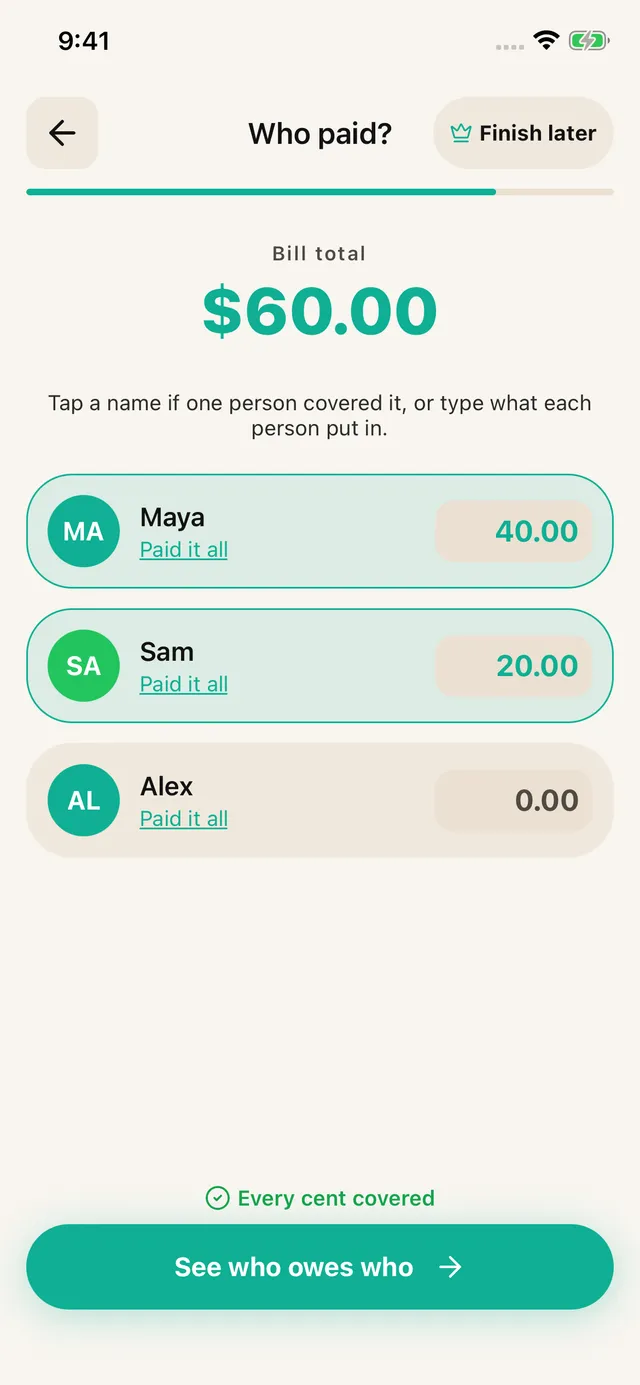
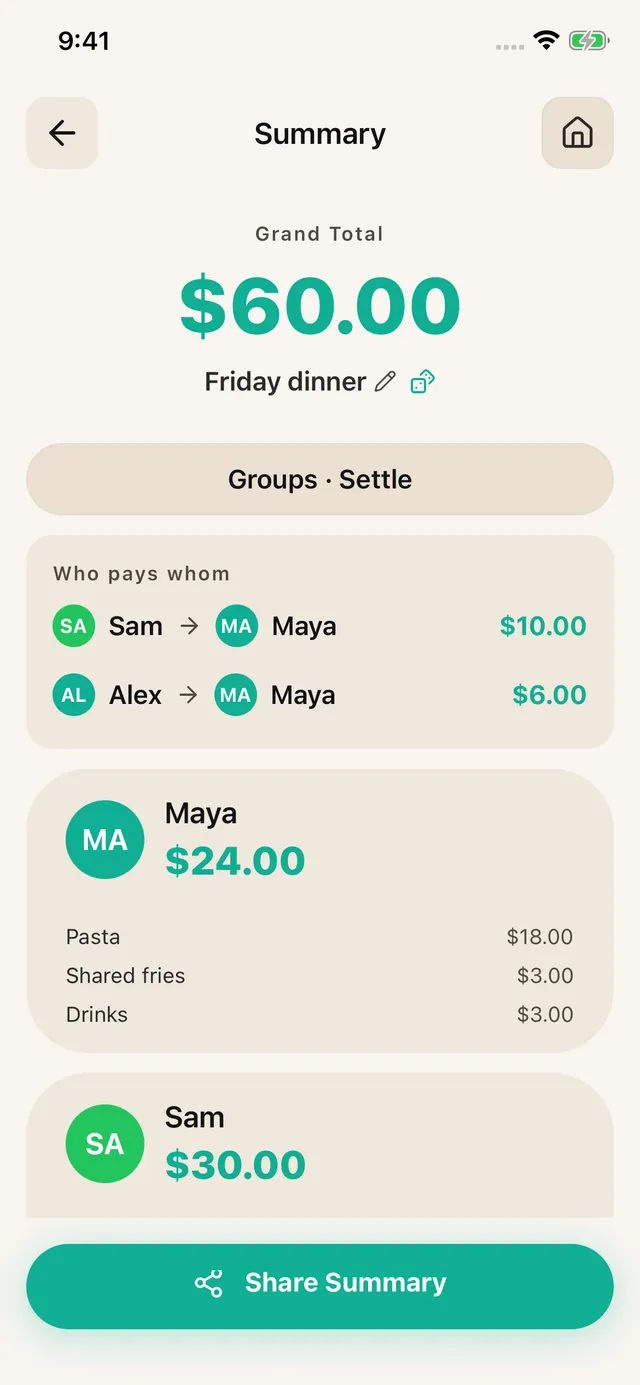
SPLIIT Pro scans the line items, assigns them to people, and prorates tax and tip based on each subtotal. Shared items can belong to several people before the fee calculation runs.
The free tier allows 7 saved contacts plus you and 3 groups. Scans refill over time. Pro removes ads and adds unlimited scans, contacts and groups, plus drafts. Past transactions remain readable for everyone.
Discounts come before percentage fees when the receipt says so
Follow the actual receipt order. If a 10% discount reduces the taxable subtotal, use the reduced values. If the restaurant calculates a service charge on the pre-discount subtotal, preserve that displayed charge and allocate it proportionally. Do not recalculate the merchant’s bill from assumptions.
Item-specific discounts stay with that item. Order-wide discounts follow each person’s eligible subtotal. Gift cards are payment methods, not discounts; The person who supplied the card should receive credit for the amount used.
Rounding without losing money
Calculate with full precision, then round each final person total to two decimals. If the rounded shares differ from the receipt by one or two cents, add or subtract the remainder from the person with the largest subtotal. Do not round every intermediate percentage, because small errors accumulate.
Check what “service charge” means
A service charge may or may not go to staff, and it may or may not replace an expected tip. The answer depends on the venue and local rules. Ask the restaurant rather than assuming. Once the group agrees on the final tip amount, the proportional split works the same way.
Verdict
Assign items first. Calculate each person’s percentage of the item subtotal. Apply that percentage to every order-wide tax, tip, or fee. Round once at the end and check that the totals match.
For the full dinner workflow, read how to split a restaurant bill fairly and how receipt scanning handles line items.
SPLIIT Pro: Assign the salad to you and the steak to the people who ate it. Share the appetizer only with those who joined in. Enter who covered the check, then share the suggested repayments. The app calculates; It does not move money.
Frequently asked questions
Should tax and tip be split evenly or proportionally?
Split them proportionally when people ordered different amounts. Each person's item subtotal determines their share of tax and tip. Equal allocation is reasonable only when the item subtotals are already similar or the group explicitly prefers speed over precision.
How do you calculate each person's share of a service charge?
Divide each person's item subtotal by the group's item subtotal, then multiply that percentage by the service charge. Repeat for tax and any order-wide fee. Round at the final person-total stage and adjust one cent if needed so every share matches the receipt.
Does a service charge replace the tip?
That depends on the venue and local practice. Read the receipt and ask the restaurant if the wording is unclear. A bill-splitting tool can allocate the numbers shown, but it cannot determine whether an additional tip is expected.