Separate Personal Purchases from Shared Household Supplies
Assign personal purchases to their owners before dividing the household supplies.
Assign personal purchases to their owners before dividing the household supplies. A single shop receipt does not make everything on it communal.
Agree which categories are shared: cleaning products, common staples or replacement equipment. Keep private toiletries and personal food outside that pool. For an appliance, also agree who owns it if someone leaves; splitting its cost does not answer that question.
Worked example
Shared supplies cost 30 units for three residents. A also buys personal items for 18 and B for 12. Total: 60. The shared part is 10 each; final shares are A 28, B 22 and C 10. An even split of the full receipt would wrongly charge C 20.
| Allocation | Amount |
|---|---|
| A | 28.00 |
| B | 22.00 |
| C | 10.00 |
| Total | 60.00 |
Record the result
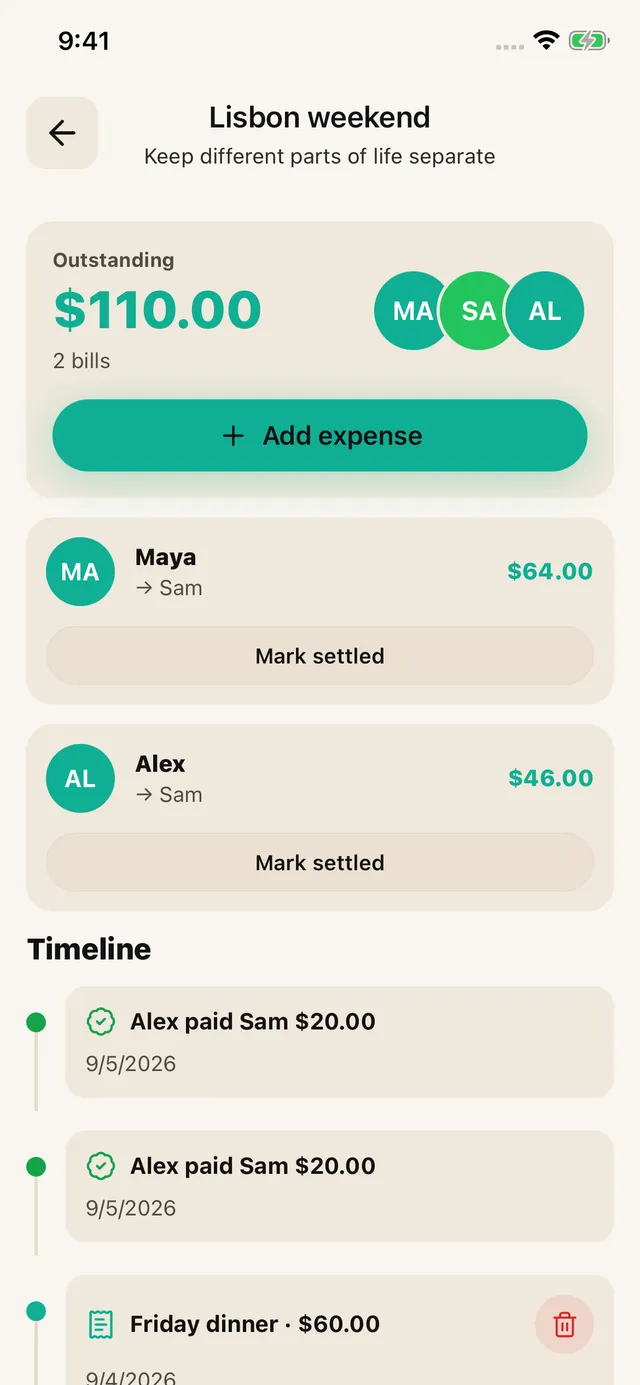
Agree the rule first, then enter the calculated amounts and actual payer in SPLIIT Pro. Assign each amount to the relevant people and review the total before sharing the breakdown. The private expense group keeps related bills and recorded partial repayments together. Friends can read shared breakdowns without installing the app; they do not edit your group. Transfer money through another method and record repayment only after it arrives.
These are illustrative units, not current prices. Use the actual bill, currency and agreement; the calculation is explained here, not promised as an automatic feature. Scanning needs a connection and review. The app is free to start with usage limits; Pro adds capacity and removes ads.
Frequently asked questions
Does everyone owe a third of a shared shopping trip?
A third of the agreed communal items, not necessarily a third of the receipt. Personal items stay with their users. Keep the receipt and the household’s category rule together so a later purchase follows the same agreement.