Split Extra Household Costs Caused by a Guest
Keep normal household costs under the existing rule.
Keep normal household costs under the existing rule. Assign an agreed, identifiable guest-related extra cost to the host, unless everyone agreed to share it.
Discuss the guest policy before a long visit: shared meals, extra bedding or a known extra utility charge. A vague rise in consumption is not evidence of an exact guest cost. Use a negotiated amount where individual usage cannot be measured, and label it as an agreement.
Worked example
The regular household pool is 90 units for A, B and C. An agreed additional guest cost is 30, assigned to host A. Total 120; shares A 60, B 30, C 30. Dividing all 120 equally would move 10 of A’s extra cost onto each other resident.
| Allocation | Amount |
|---|---|
| A | 60.00 |
| B | 30.00 |
| C | 30.00 |
| Total | 120.00 |
Record the result
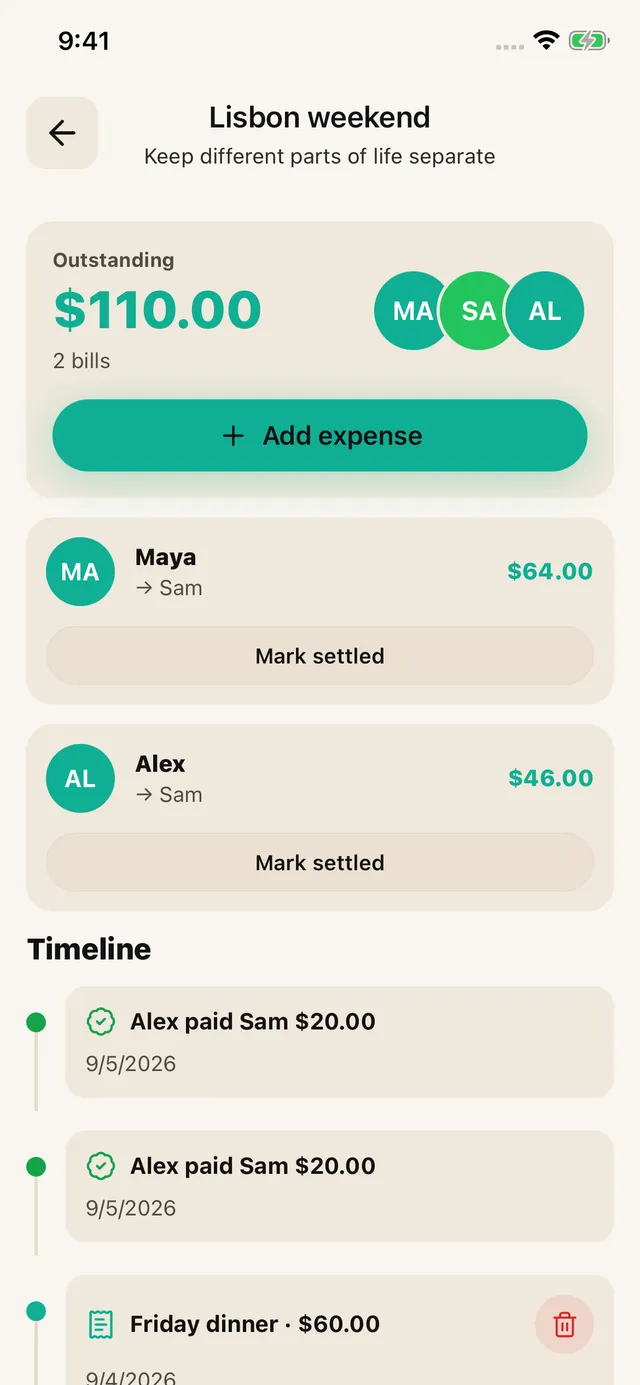
Agree the rule first, then enter the calculated amounts and actual payer in SPLIIT Pro. Assign each amount to the relevant people and review the total before sharing the breakdown. The private expense group keeps related bills and recorded partial repayments together. Friends can read shared breakdowns without installing the app; they do not edit your group. Transfer money through another method and record repayment only after it arrives.
These are illustrative units, not current prices. Use the actual bill, currency and agreement; the calculation is explained here, not promised as an automatic feature. Scanning needs a connection and review. The app is free to start with usage limits; Pro adds capacity and removes ads.
Frequently asked questions
Should guests automatically increase everyone’s share?
No automatic rule is fair in every household. Separate the ordinary pool from identifiable or agreed extras. If there is no evidence for a precise amount, settle the household agreement before entering a supposed measurement.