How to Split Work Trip Expenses With Colleagues
How to split work trip expenses with colleagues — separating what the company reimburses from what you split personally, with a worked dinner example.
You’re at a conference with three coworkers. The flights and hotel went through corporate booking, no problem. But then it’s day two, someone suggests a team dinner at a real restaurant, two people grab a cab back separately, and someone picks up a round of coffees for the group before the morning session. None of that fits neatly into “company pays” or “we split it” — and figuring out how to split work trip expenses with colleagues is less about math and more about not making it weird with people you’ll see in a meeting on Monday.
The core issue is that a work trip runs two separate expense systems at once: what the company reimburses through an expense report, and what colleagues personally split because it’s social, discretionary, or just easier to handle in cash. Mixing the two is where things go sideways — someone accidentally double-dips on an expense report, or someone quietly resents fronting money that never gets settled.
How to Split Work Trip Expenses With Colleagues: Draw the Line Early
Before the trip, or at latest on day one, it’s worth a quick group text: “Flights and hotel are direct-billed. Anything else — meals, cabs, incidentals — we’re splitting between us and expensing individually where it applies.” That one sentence prevents most of the confusion. The goal is a clear boundary: reimbursable-by-company stuff goes on someone’s expense report, and everything else gets split among the people who were actually there.
The Team Dinner Problem
Here’s the scenario that trips people up. Four colleagues go to dinner — $180 total. Two of them are senior enough that their company covers a client-adjacent dinner like this on their expense report. The other two are not going to expense it; It’s just a group hang. Nobody wants to be the one who says “actually I’m expensing this” mid-meal, and nobody wants to awkwardly split a check four ways when half the group is getting reimbursed anyway.
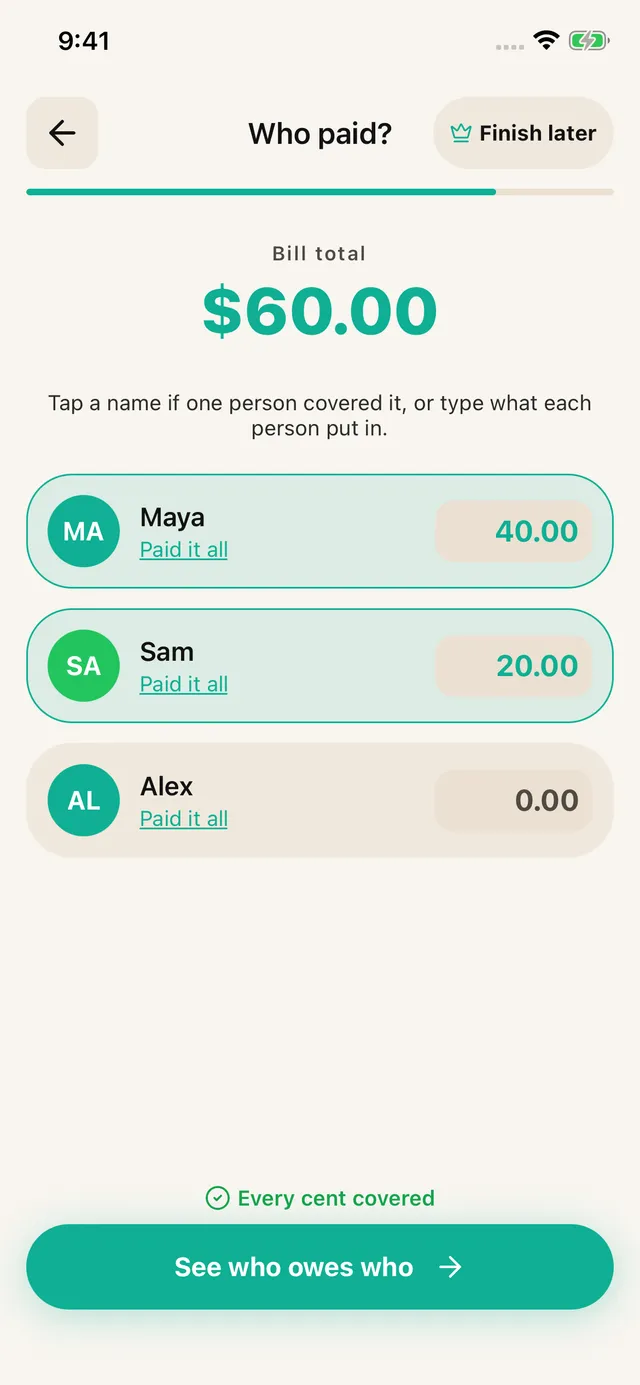
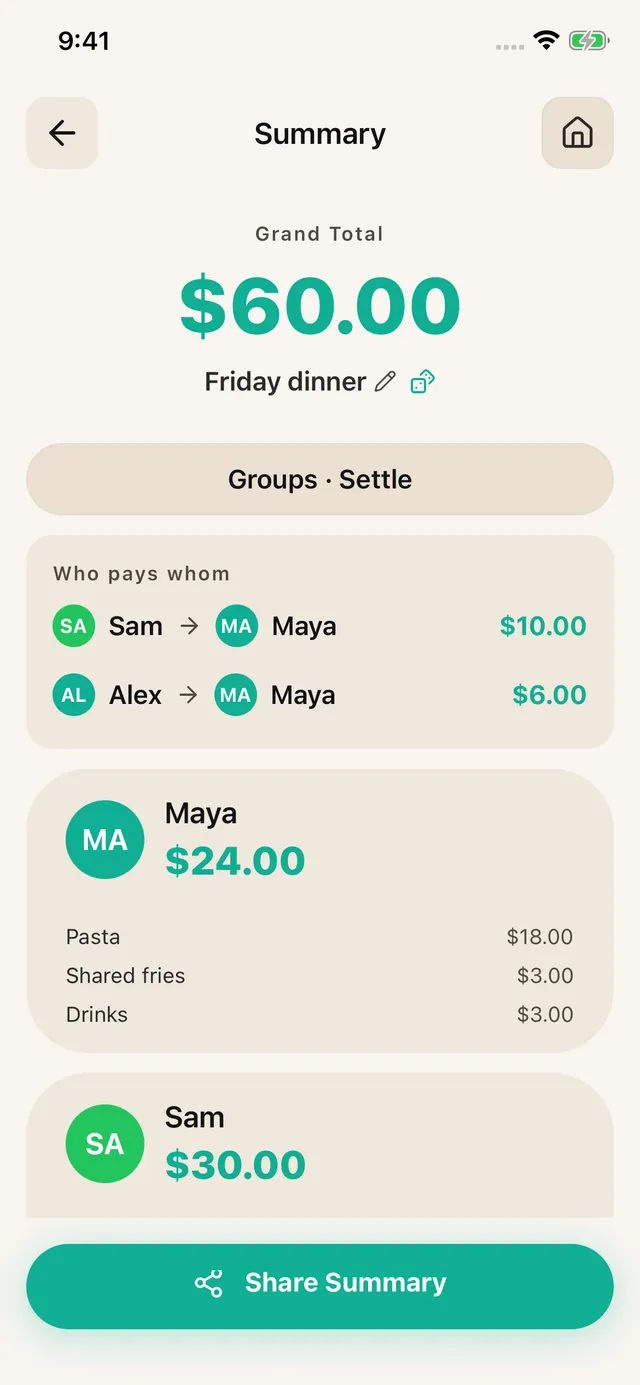
The cleanest fix: the two who’ll expense it split $90 between them and each puts it on their own expense report (most companies want the itemized meal on your own card, not someone else’s). The other two split the remaining $90, personally, no reimbursement. That’s $45 each on the expense-report side and $45 each out of pocket. Nobody has to announce their reimbursement situation to the table — whoever’s paying just settles it after, and a shared record keeps track of who owes what to whom. Reconciling this after the fact, once everyone’s home and has actually submitted their reports, beats trying to sort it out over the check.
The Shared Uber and Other Small Stuff
A ride from the airport, a round of drinks after a long session, a shared cab back from the client dinner — these rarely map cleanly to “company covers it.” Some companies will reimburse a shared Uber if you’re the one who paid and submit the receipt; Others won’t touch anything that isn’t itemized per person. Don’t assume. If in doubt, split it among the colleagues who rode along, log it, and let each person independently decide whether it’s worth submitting to their own expense report. It’s not your job to adjudicate someone else’s company policy.
SPLIIT Pro: Upload the delivery screenshot and check the final discounts and fee lines. Assign each meal and any shared sides. Share the itemized amounts. Record the payer and use collection reminders to check unpaid shares later. Reminders come to you.
Keep the Receipts, Even for the Personal Split
This is the part people skip and regret. Even for expenses you’re not planning to submit to your own company, hang onto the receipt or a photo of it for a week or two after the trip. Two reasons: first, expense report line items sometimes get questioned, and having the original itemized receipt (even if a colleague “owns” the expense report) saves an awkward Slack thread later. Second, if the group is settling up after the trip and someone disputes an amount, the receipt ends the conversation instantly instead of turning into a memory contest.
When to Just Let It Go
Not every work trip expense is worth splitting to the cent. If one colleague grabs a round of $4 coffees for the team twice over a three-day trip, that’s not a debt — that’s just a nice colleague, and the social cost of itemizing it outweighs the $8. Save the actual tracking for anything over roughly $20–25, or anything clearly uneven, like a dinner where costs varied a lot per person. For the small stuff, trade off buying rounds and don’t keep score.
For the broader mechanics of managing costs across any group trip, see how to split group travel expenses without chaos. If your team is traveling internationally, multi-currency group trip expenses covers the exchange-rate wrinkle. And if this trip reveals that one colleague is chronically slow to settle up, what to do about a friend who never pays you back has scripts that work just as well for coworkers.